
By Dr. Sajeev M S | Educator | Principal | Teacher Trainer | Author | 20+ Years of Experience
The UDISE+ 2025–26 Report, released by the Ministry of Education, Government of India, on 7 July 2026, provides valuable information to examine these questions.
India has one of the world’s largest school education systems. Millions of children enter classrooms every year, thousands of schools work towards improving educational standards, and teachers play a central role in shaping the country’s future.
But how well is our school education system progressing? Are schools providing the facilities students need? Do teachers have manageable classroom responsibilities? Are children continuing their education? And are we making sufficient progress towards quality and inclusive education?
The Unified District Information System for Education Plus (UDISE+) is an important national database that collects information about schools, students, teachers and educational facilities across India. Its findings help policymakers, education administrators and school leaders understand the condition of school education and identify areas that require attention.
Let us examine some important findings of the latest report and understand what they mean for teachers, principals and educational institutions.
1. India Has a Massive School Education Network
According to UDISE+ 2025–26, India has approximately:
- 14.67 lakh schools
- 24.72 crore students
- 1.03 crore teachers
These figures demonstrate the enormous scale of India’s school education system.
However, the real responsibility of a school is not simply to enrol children. Every school must ensure that students receive meaningful learning experiences, develop essential skills and progress towards their educational goals.
What should school leaders do?
As a principal, regularly examine your school’s enrolment, attendance, academic progress and learning outcomes. Do not measure institutional success only through the number of admissions or examination results. Give equal importance to the actual development of every student.
2. The Pupil–Teacher Ratio Has Improved
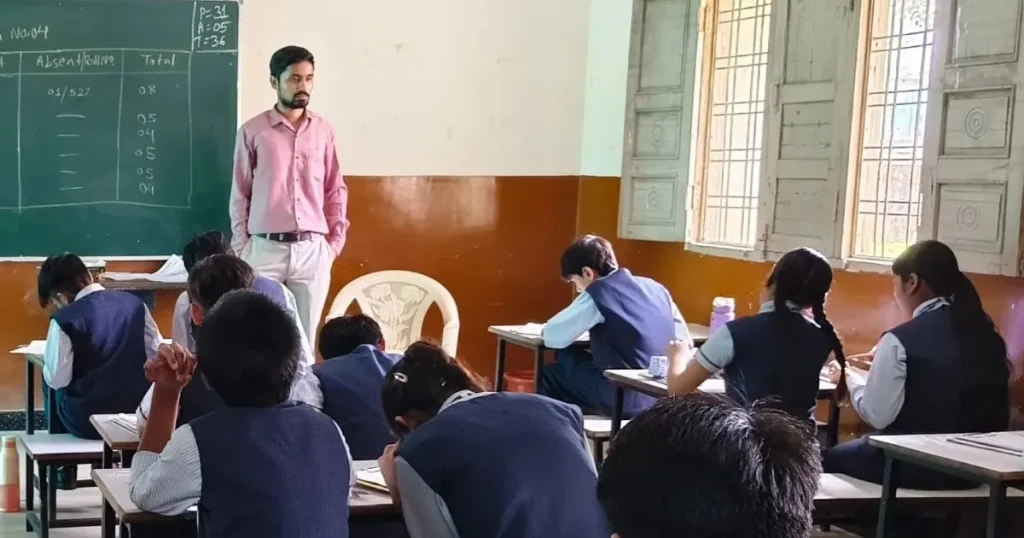
The report highlights an improvement in the Pupil–Teacher Ratio (PTR) across different educational stages.
The reported national ratios are:
| Educational stage | Pupil–Teacher Ratio |
| Foundational | 10:1 |
| Preparatory | 12:1 |
| Middle | 17:1 |
| Secondary | 21:1 |
A favourable pupil–teacher ratio can create opportunities for individual attention, meaningful interaction and better classroom support.
However, a lower PTR does not automatically guarantee quality teaching. The effectiveness of classroom instruction depends on teachers’ preparation, subject knowledge, teaching methods and ability to understand individual learning needs.
What should teachers do?
- Identify students who need additional academic support.
- Encourage classroom participation rather than one-way teaching.
- Give individual feedback wherever possible.
- Use group activities to promote peer learning.
- Monitor the progress of students regularly.
Remember, the purpose of having teachers in classrooms is not merely to complete the syllabus but to ensure that children learn.
3. School Dropout Rates Show Improvement
Keeping children in school until they complete their education remains an important responsibility of the education system.
The UDISE+ 2025–26 report records the following dropout rates:
| Educational stage | Dropout rate |
| Preparatory | 1.8% |
| Middle | 3.6% |
| Secondary | 7.0% |
The secondary-stage dropout rate declined from 8.2% in 2024–25 to 7.0% in 2025–26.
This is encouraging progress. However, the secondary stage continues to require particular attention.
A student may leave school because of financial difficulties, family circumstances, academic challenges, lack of interest, social pressures or other personal reasons.
What should school principals do?
- Monitor student attendance regularly.
- Identify students with repeated absences.
- Contact parents when attendance becomes irregular.
- Provide academic support to students who fall behind.
- Create a welcoming and supportive school environment.
- Work with parents to prevent avoidable school discontinuation.
Do not wait until a student stops attending school to take action. Early identification and timely intervention can make a significant difference.
4. School Infrastructure Is Gradually Improving
A supportive learning environment requires more than classrooms and textbooks. Students need basic facilities that promote safety, hygiene, dignity and participation.
The report highlights the availability of several important facilities across Indian schools.
| School facility | Availability |
| Safe drinking water | 99.5% |
| Girls’ toilets | 98.5% |
| Boys’ toilets | 97.2% |
| Electricity | 95.0% |
| Handwashing facilities | 96.9% |
| Libraries | 90.5% |
| Ramps with handrails | 58.2% |
These figures indicate substantial progress in basic school infrastructure.
However, the availability of ramps with handrails in only 58.2% of schools highlights the continuing need to strengthen accessibility for children with disabilities.
What should school leaders do?
Conduct regular infrastructure inspections. Check drinking water, classroom ventilation, toilets, playgrounds, libraries, electricity and accessibility facilities. Ensure that students can use these facilities safely and comfortably.
A well-maintained school environment communicates care, responsibility and respect for every child.
5. Digital Education Needs Greater Attention
Technology is becoming an important part of modern education. Computers and digital learning facilities can provide students with opportunities to explore information, develop technological skills and access new learning resources.
However, the availability of digital facilities is not uniform across all schools.
The national UDISE+ data indicate that computer access has increased to approximately 69.9% of schools in 2025–26.
This means that a considerable proportion of schools still need improved access to computers.
But purchasing computers alone will not transform education.
What should principals and teachers do?
- Develop a practical timetable for computer laboratory use.
- Provide basic digital literacy opportunities to students.
- Train teachers to use technology meaningfully.
- Use digital resources to explain difficult concepts.
- Encourage responsible and safe technology use.
Technology should support teaching and learning, not become a substitute for effective teachers and meaningful classroom interaction.
6. Girls’ Participation and Women’s Representation Are Encouraging
The report highlights positive progress in gender representation in school education.
Girls account for 48.4% of total student enrolment, while women constitute 54.9% of the teaching workforce.
These figures reflect the important participation of girls in education and women in the teaching profession.
However, equal participation must also be supported by equal opportunities, safety, leadership development and access to quality education.
What should schools do?
Encourage girls to participate in sports, leadership activities, science projects, technology programmes and classroom discussions. Provide equal opportunities to every student and create an environment where children feel respected and confident.
7. School Data Must Lead to Better Educational Decisions
One of the most important messages of UDISE+ is the importance of data-driven educational planning.
Schools generate valuable information every academic year through attendance registers, examination results, enrolment records, teacher details and infrastructure assessments.
But collecting information is only the beginning. The real value of data lies in how schools use it to improve their functioning.
For example:
- If attendance is declining, investigate the reasons.
- If examination performance is poor, review teaching strategies.
- If reading ability is below expectations, introduce a structured reading programme.
- If teachers have excessive responsibilities, review the workload distribution.
- If parents are dissatisfied, strengthen communication and support systems.
As a principal, ask yourself one important question: Are we using our school data to improve learning, or are we collecting information only to complete official requirements?
What Does This Report Mean for the Future of Indian Schools?
The UDISE+ 2025–26 report presents encouraging developments in teacher availability, pupil–teacher ratios, school infrastructure, gender representation and student retention.
At the same time, the findings remind us that improving school education requires continuous attention to learning quality, accessibility, digital facilities and student retention.
Every school has a responsibility to convert educational policies and statistical information into meaningful action.
A favourable pupil–teacher ratio must result in better classroom interaction. Improved infrastructure must create a safer learning environment. Digital facilities must support meaningful learning. Better attendance must lead to better educational achievement.
These changes become possible when school leaders, teachers, parents and educational authorities work together.
A Message to Every School Principal and Teacher
Educational reports are not simply collections of numbers. They are opportunities to understand where we stand, recognise what needs improvement and decide what we should do next.
As a teacher, look beyond syllabus completion and focus on what your students are actually learning.
As a principal, look beyond school statistics and examine the quality of educational experiences your institution provides.
As an educator, remember that every percentage represents real children, every school represents a learning community, and every improvement creates an opportunity for a better future.
The success of education cannot be measured only by how many children enter schools. It must also be measured by how much they learn, how confidently they grow and how successfully they prepare for life.
FAQs
1. What is the UDISE+ 2025–26 report?
UDISE+ 2025–26 is an official report published by India’s Ministry of Education. It provides information about schools, students, teachers, infrastructure and other important educational indicators.
2. How many schools are there in India according to UDISE+ 2025–26?
India has approximately 14.67 lakh schools, 24.72 crore students and 1.03 crore teachers, according to the report.
3. What is the pupil–teacher ratio in India in 2025–26?
The reported ratios are 10:1 at the Foundational stage, 12:1 at the Preparatory stage, 17:1 at the Middle stage and 21:1 at the Secondary stage.
4. What is the secondary school dropout rate in India?
The reported secondary-stage dropout rate is 7.0% in 2025–26, compared with 8.2% in 2024–25.
5. Why is the UDISE+ report important for school principals?
It helps school principals understand national education trends, evaluate school infrastructure, examine teacher availability and make informed decisions about school improvement.
Official references
- Ministry of Education – UDISE+ Publications.
- Government of India – Official UDISE+ 2025–26 release (7 July 2026).
- PIB – Beyond the Numbers: Decoding India’s School Education Progress (17 August 2026).
Original report PDF: Download UDISE+ 2025–26 – Existing Structure (PDF).
Editorial note: UDISE+ primarily provides administrative and school-system statistics. It should not be treated as a direct assessment of children’s reading, writing or mathematical proficiency. Those learning outcomes require separate assessment evidence.
You may like to read: –
- Why Are School Admissions Falling? 15 Practical Strategies for School Leadership
- UDISE+ 2025–26 Report: Key Findings on Indian School Education
- UNESCO Education Report 2026: Access and Equity
- The Power of a Positive Attitude: Know Simple Ways for Teachers
- Student Absenteeism & Motivation: Practical Strategies
Quite educative n essential n effective information for we like Principal….who are striving n struggling for the betterment of Schools…
Your suggestion is our energy.
I am a teacher.so your article is very useful for me.
I will like to know about how a principal can really manage an institution well


Educational & Management Expert, Accredited Teacher & Soft Skills trainer,Certified Counselor,Writer, and Author
There are important techniques to practice for all educators. Appreciate for sharing it.