

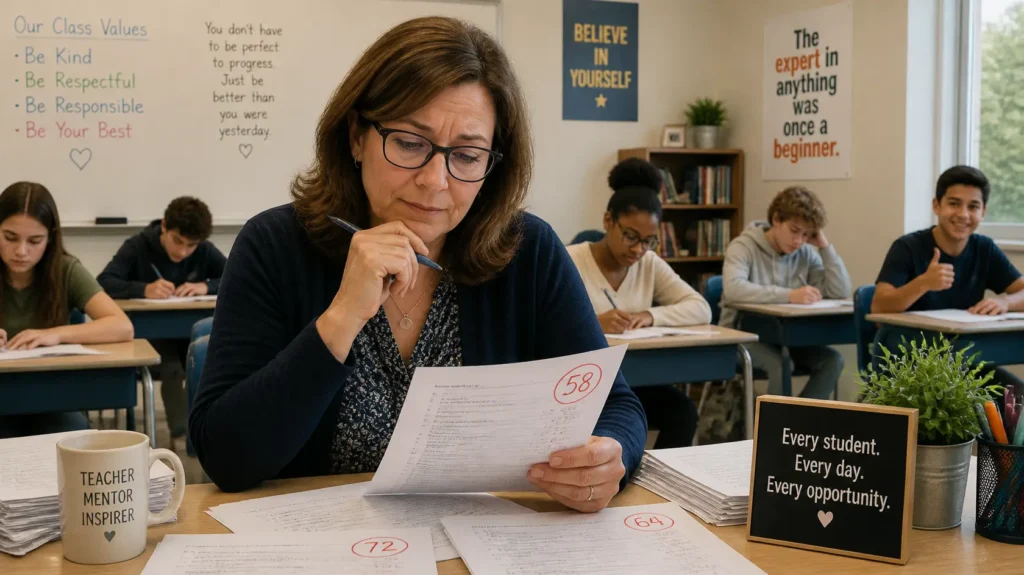
Have you ever given your best in the classroom but still felt disappointed with your students results?
You prepare lessons, explain concepts, check notebooks, give homework, and spend extra time helping difficult learners. Yet, when examination results arrive, they do not reflect your hard work. It can be discouraging. But poor results do not always mean that you are a poor teacher. Sometimes, the problem is not how much you teach, but how effectively your students learn.
Let us find six reasons behind these results and what you can do to improve your students results.
1. You Focus More on Teaching Than Learning
You may complete every chapter in the syllabus, but have your students understood the concepts? You may explain a topic perfectly while some students remain confused.
What can you do? Pause during your lesson and ask students to explain the concept in their own words. Their responses will help you understand whether learning is actually taking place.
Practical tip: Before moving to the next topic, ask three short questions. Let students answer individually on paper or on their mini-whiteboards. Review their answers and explain any concept they have not understood.

2. You Provide the Same Attention to Every Student
Every student is not learning at the same pace. Some understand quickly, while others need more time, practice, and individual support. For example, a student who cannot read an English question independently may perform poorly in examinations even if they understand the subject.
What can you do? You can identify learning gaps and provide additional support to students who need it most.
Practical tip: Divide students into three flexible groups based on their current learning needs. Give additional guidance to struggling learners, practice activities to students developing the skill, and challenging tasks to those who have mastered it. Review their progress regularly.
3. You Encourage Memorization More Than Understanding
Students may memorize answers and reproduce them in examinations. However, they may have difficulty when questions are presented differently.
What can you do? Ask students to explain ideas, give examples, and answer questions in their own words. Understanding helps them apply knowledge more confidently.
Practical tip: After teaching a concept, ask students to explain it without looking at their textbooks. Give them a new example or a differently worded question to check whether they can apply what they have learned.

4. You Check Answers but Miss the Learning Gaps
Correcting notebooks is important, but simply marking answers does not always help students improve. If the same mistakes appear repeatedly, you need to identify their causes.
What can you do? Discuss common mistakes, demonstrate the correct method, and give students another opportunity to practice.
Practical tip: Maintain a simple error record for each class. Note the three most common mistakes in a test, reteach those concepts, and give students five similar questions to solve. Check whether their mistakes decrease.
5. Your Students May Lack Confidence
Some students know the answers but feel nervous to respond because they fear making mistakes. When students are afraid of being embarrassed, they may stop asking questions and hide their difficulties.
What can you do? Appreciate their efforts, correct mistakes respectfully, and make your classroom a safe place to learn.
Practical tip: Give students 30 seconds to think before answering. Let them discuss their answers with a partner before inviting responses. Appreciate sincere attempts and explain mistakes without embarrassing anyone.
6. You May Not Reflect on Your Teaching Methods
Hard work is valuable, but repeating the same teaching method may not solve a persistent learning problem.
What can you do? After a disappointing test, ask yourself: “What did my students find difficult? What can I change in my next lesson?” Sometimes, a small change in your approach can make learning easier.
Practical tip: After each test, identify one topic that many students found difficult. Try a different approach, such as using a diagram, a real-life example, a demonstration, or peer teaching. Give a short follow-up assessment to check whether the new approach helped.
Conclusion
Hardworking teachers deserve appreciation. But students also deserve teaching that helps them make genuine progress. You do not measure your success only by the number of lessons completed or hours spent working. Teaching is your effort. Learning is the goal.
5 FAQs
1. Why do hardworking teachers sometimes get poor results?
Hardworking teachers may get poor results when students have learning gaps, lack confidence, rely on memorisation, or do not fully understand the concepts being taught.
2. How can teachers improve students academic performance?
Teachers can improve academic performance by identifying learning gaps, providing individual support, checking understanding regularly, and giving students opportunities to practise.
3. Why is completing the syllabus not enough to ensure good results?
Completing the syllabus does not guarantee that every student has understood the concepts. Teachers should assess students understanding and address difficulties before moving forward.
4. How can teachers help students who struggle with examinations?
Teachers can provide additional practice, explain difficult concepts in simple language, develop reading and comprehension skills, and conduct short assessments to monitor progress.
5. What should teachers do when students repeatedly perform poorly in tests? Teachers should analyse students mistakes, identify common learning difficulties, adjust their teaching methods, and reassess students after providing targeted support.
You may like to read:-
- Before You Correct a Child, Ask Yourself This One Question
- Why Do Hardworking Teachers Sometimes Achieve Poor Results? 6 Reasons and Solutions
- How to Improve English Reading Skills in Your School: A Practical 90-Day Plan
- Teacher Empathy: 7 Ways to Build Strong Student Relationships
- 6 Effective Communication Skills That Make You a Better Teacher
I am a teacher.so your article is very useful for me.
I will like to know about how a principal can really manage an institution well
Thanks! I understood a lot of things that I did without reading this post. I will reuse this information when…
This is wonderful. This report is fantastic.


Educational & Management Expert, Accredited Teacher & Soft Skills trainer,Certified Counselor,Writer, and Author


Your suggestion is our energy.