
By Dr. Sajeev M S | Educator | Principal | Teacher Trainer | Author
With over 20 years of experience in education, school leadership and teacher training, I believe that every girl deserves the opportunity to learn, grow and build an independent future. Gender equality in education is a must.
Article Outline
1. Introduction: A World Making Progress, but Not Yet Equal
2. What Does the 2026 UNESCO Report Reveal?
3. The Numbers Behind Girls’ Education
4. India’s Rural Education Gap: A Concern That Needs Attention
5. Early Marriage: When Childhood Dreams Are Interrupted
6. Early Pregnancy and the Right to Continue Education
7. Poverty, Social Expectations and Gender Discrimination
8. The Importance of Safe and Supportive Schools
9. What Governments and Policymakers Must Do
10. The Responsibility of School Leaders and Principals
11. What Teachers Can Do to Promote Gender Equality
12. The Role of Parents and Families
13. Education as a Powerful Tool for Social Transformation
14. Building a Future Where Every Girl Can Learn
15. Conclusion: A Girl’s Education Is an Investment in Humanity
1. Introduction: A World Making Progress, but Not Yet Equal
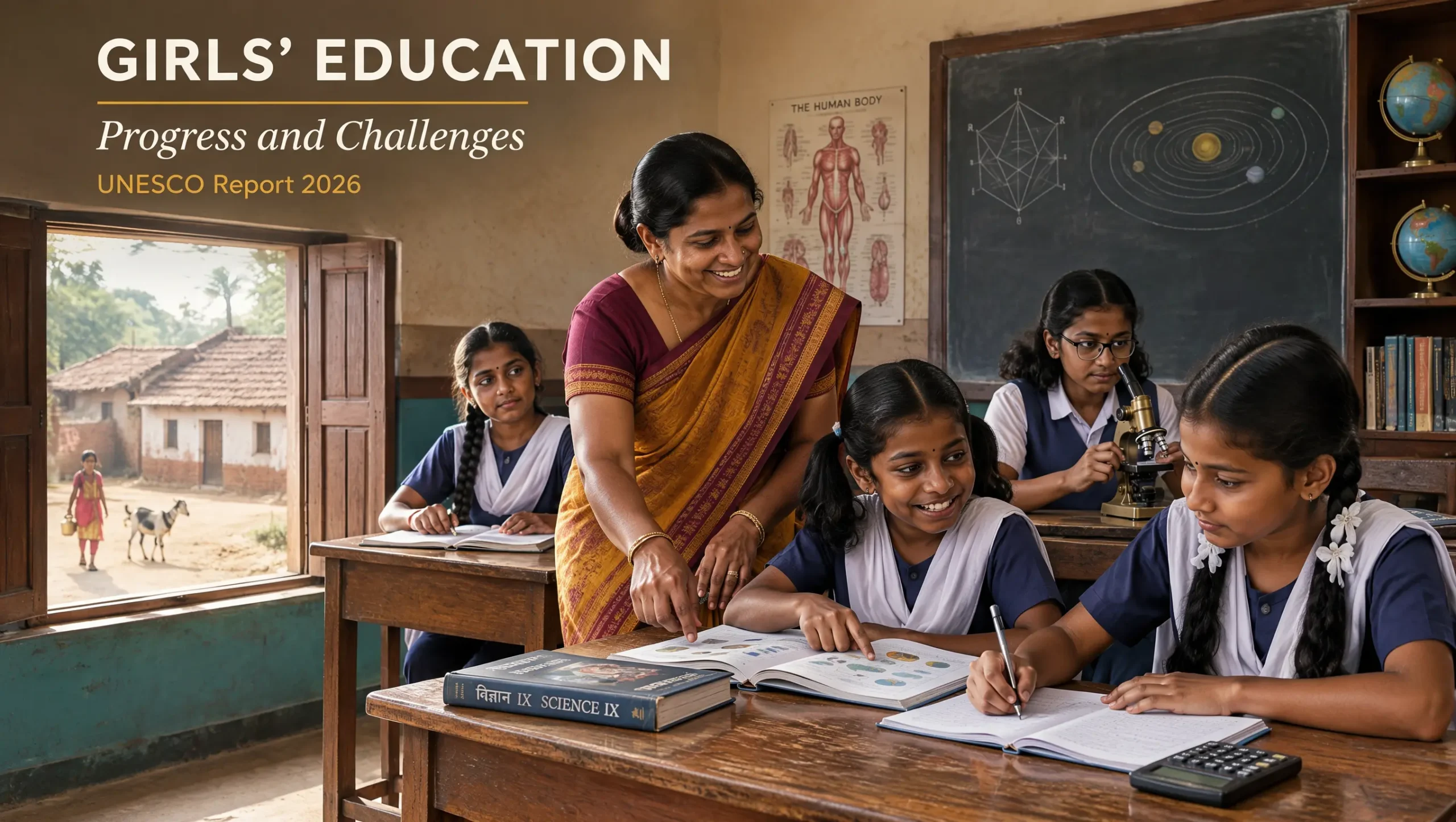
Imagine a classroom filled with enthusiastic students. Girls and boys sit together, read the same textbooks, participate in activities and dream about becoming doctors, teachers, scientists, engineers and leaders. Their opportunities appear equal. Yet, outside the classroom, some girls face a completely different reality. While their brothers continue their education, they may be expected to take responsibility for household work, leave school early, get married or become mothers before they are ready. This contrast highlights one of the most important challenges facing education systems across the world: ensuring that every girl has the opportunity not only to enter school but also to complete her education and pursue her dreams.
Education has made remarkable progress in promoting gender equality over recent decades. More girls are attending schools, completing examinations and entering higher education than in previous generations. However, access to education does not automatically guarantee equal opportunities. Social expectations, poverty, early marriage, teenage pregnancy and inadequate institutional support continue to interrupt the educational journeys of millions of girls. These challenges remind us that gender equality cannot be measured only by counting how many girls and boys enter classrooms. We must also examine who completes school, who receives encouragement, who feels safe and who gets the freedom to make decisions about their future.
A report released by UNESCO on 8 October 2026 brings this issue into focus. Its central message is encouraging but also deeply concerning: gender gaps in education are narrowing globally, yet early marriage and early pregnancy continue to prevent many girls from completing their education. The report invites governments, school leaders, teachers, parents and communities to look beyond enrolment figures and take meaningful action to protect every girl’s right to learn.
2. What Does the 2026 UNESCO Report Reveal?
The 2026 UNESCO Global Education Monitoring (GEM) Gender Report examines progress towards gender equality in education and identifies the barriers that continue to affect girls’ educational opportunities. Published ahead of the International Day of the Girl Child, observed on 11 October, the report highlights an important achievement: gender parity in enrolment has been reached globally from pre-primary through upper secondary education. This means that, at the global level, girls and boys are now enrolled in similar numbers across these stages of schooling.
However, UNESCO makes it clear that global progress should not create a false impression that the problem has been solved. Educational inequalities remain within countries, particularly among children from poor households and those living in rural and disadvantaged communities. A girl living in a well-developed urban area may have access to good schools, transport, technology and parental support, while another girl in a remote village may face several obstacles simply to attend school regularly.
The report also highlights the connection between education, marriage and motherhood. Although the proportion of girls married before the age of 18 has declined, millions of girls continue to experience early marriage and pregnancy. Many never return to school after becoming mothers. This is particularly serious in regions where education systems lack flexible arrangements, childcare facilities and supportive policies.
The report therefore encourages a broader understanding of educational equality. It is not enough to open school gates and announced that education is available to everyone. Governments and institutions must create conditions in which girls can remain in school, complete their studies and use their education to build meaningful lives.
2.1 Progress Towards Gender Parity
One of the encouraging findings of the report is the progress several countries have made in reducing gender inequalities. Nepal, for example, closed a 33-percentage-point gap in lower secondary school completion between girls and boys between 1990 and 2024. Cambodia experienced a remarkable change in primary school completion: girls, who were 22 percentage points behind boys in 1981, were 11 percentage points ahead in 2024.
Saudi Arabia reduced its gender gap in tertiary enrolment by three-quarters between 2006 and 2022. Costa Rica also made progress, reducing the upper secondary completion gap favouring girls from 12 percentage points to seven across the periods 2011–17 and 2018–24.
These examples demonstrate that educational inequalities are not permanent. With appropriate policies, investment, public awareness and institutional commitment, countries can bring meaningful improvements. They also show that progress requires consistent action rather than occasional campaigns or temporary initiatives.
2.2 Why Equal Enrolment Does Not Mean Equal Opportunity
Imagine two students, a girl and a boy, entering Class VI at the same age. Both have similar academic abilities and receive admission to the same school. However, the boy receives encouragement to continue studying, while the girl is increasingly expected to help with household responsibilities. As the years pass, her attendance becomes irregular, her learning suffers and her chances of completing secondary education decrease.
Their educational journeys may begin equally, but their opportunities are no longer the same.
This is why enrolment statistics must be examined alongside attendance, learning outcomes, grade progression and school completion. A country may achieve gender parity in enrolment while certain communities continue to experience serious inequalities. True gender equality means giving every learner a fair opportunity to succeed, regardless of gender, family income or geographical location.
3. The Numbers Behind Girls’ Education
Statistics help us understand the scale of an issue that can otherwise remain hidden behind individual experiences. UNESCO’s 2026 report presents several important figures that deserve the attention of educators, policymakers and society.
| Indicator | UNESCO’s reported findings |
| Girls married before age 18 globally in 2000 | 25% |
| Girls married before age 18 globally in 2025 | 18% |
| Child marriage in Central and Southern Asia | 25% |
| Child marriage in sub-Saharan Africa | 31% |
| Pregnant and young mothers aged 10–19 out of school in sub-Saharan Africa in 2024 | 6 million |
| Pregnant and parenting girls returning to school in the region | Fewer than 5% |
| Countries guaranteeing education without sex or gender discrimination in their legal frameworks in 2026 | 58% |
| Countries explicitly protecting the education rights of pregnant and parenting girls in 2026 | 35% |
Source: UNESCO, 2026 Global Education Monitoring Gender Report and accompanying announcement.
The decline in child marriage from 25% in 2000 to 18% in 2025 represents important progress. However, the remaining figure is still deeply concerning. Nearly one in five girls, according to this indicator, continues to face marriage before reaching adulthood. Behind every percentage is a young person whose education, health, independence and future opportunities may be affected.
The regional figures also deserve attention. Child marriage remains particularly prevalent in sub-Saharan Africa, where the reported proportion is 31%. In Central and Southern Asia, it stands at 25%. These differences demonstrate that global progress is uneven and that educational policies must respond to local realities.
Perhaps one of the most disturbing findings concerns young mothers. UNESCO estimates that six million pregnant and young mothers aged 10–19 were out of school in sub-Saharan Africa in 2024. Fewer than five per cent of pregnant and parenting girls in the region return to education. This tells us that the challenge does not end when a girl leaves school because of pregnancy. In many cases, the education system fails to provide a practical pathway for her return.
These numbers should encourage us to ask an important question: Are our education systems doing enough to ensure that a temporary interruption does not become a permanent end to a girl’s learning journey?
4. India’s Rural Education Gap: A Concern That Needs Attention
India has made considerable progress in expanding educational opportunities for girls. Government initiatives, school infrastructure development, scholarships, awareness programmes and greater participation of families have contributed to improving access to education. More girls are entering schools, pursuing higher studies and choosing careers that were less accessible to previous generations. However, the UNESCO report highlights an important inequality that deserves particular attention.
According to the report, gender parity in upper secondary education completion has been achieved in India’s urban areas. However, in rural areas, only 59 girls complete upper secondary education for every 100 boys. This finding reveals that geographical location continues to influence educational opportunities.
The difference between urban and rural educational experiences cannot be explained by one factor alone. Families in rural communities may face financial difficulties, limited access to secondary schools, inadequate transport facilities and social expectations that place additional responsibilities on girls. In some areas, parents may hesitate to send adolescent girls to schools located far from their villages because of concerns about safety and travel. Household responsibilities can also affect attendance, particularly when girls are expected to care for younger siblings or assist with domestic work.
Another concern is the transition from middle school to secondary and higher secondary education. A girl may successfully complete Class VIII but find it difficult to continue because the nearest higher secondary school is far away. Even when a school is available, transportation expenses, family income and social attitudes may influence whether she continues studying.
This is where schools, local authorities and communities must work together. Improving rural education requires more than constructing classrooms. It demands reliable transport, safe school environments, qualified teachers, appropriate sanitation facilities, financial support and regular communication with parents. Schools must also identify students who are at risk of dropping out and intervene before their attendance becomes irregular.
The Indian education system has an important opportunity to convert access into achievement. Every rural girl who completes secondary education represents progress not only for her family but also for her community and the country.
5. Early Marriage: When Childhood Dreams Are Interrupted
Every child deserves the opportunity to experience childhood, explore interests, develop skills and prepare for adulthood. Yet, early marriage takes away many of these opportunities from girls. Instead of concentrating on education, friendships and personal development, a young girl may suddenly be expected to take on responsibilities that require emotional, social and financial maturity.
Early marriage is not simply a family or cultural decision. It can become a serious educational barrier. When a girl marries before completing her studies, she may be expected to leave school, relocate to another household or prioritise domestic responsibilities. In many situations, continuing education becomes difficult because of family expectations and a lack of practical support.
Consider a student who dreams of becoming a doctor. She performs well in school, enjoys science and has the encouragement of her teachers. However, her family decides that marriage is more important than further education. Her academic journey ends before she has the opportunity to discover what she could achieve. Her ability has not disappeared, and her dreams have not necessarily changed. What has changed is the freedom and opportunity available to her.
This is the human reality behind the statistics on child marriage.
5.1 The Connection Between Early Marriage and School Dropout
The relationship between early marriage and school dropout is complex. In some communities, girls leave school because marriage is arranged for them. In other situations, families withdraw girls from education because they believe that further schooling is unnecessary once marriage becomes a priority. Sometimes, financial hardship encourages families to invest in boys’ education while expecting girls to prepare for marriage and household responsibilities.
These decisions can create a cycle of disadvantage. A girl who leaves school early may have fewer opportunities to develop professional skills, access employment or become financially independent. Limited economic opportunities can increase her dependence on others and reduce her ability to make decisions about her own life.
Education provides knowledge, confidence and the ability to understand personal rights. It also helps young people evaluate opportunities and make informed decisions. When early marriage interrupts education, the consequences can extend far beyond the school years.
Preventing early marriage therefore requires cooperation between schools, families, community leaders, governments and social organisations. Awareness programmes must explain the importance of education, while institutions must ensure that girls have access to continued learning and appropriate protection.
6. Early Pregnancy and the Right to Continue Education
One of the most important messages in the UNESCO report is that pregnancy and motherhood should not automatically bring a girl’s educational journey to an end. A young mother may face several difficulties, including health-related responsibilities, childcare, financial pressure, family expectations and social stigma. However, these circumstances should not become reasons for permanently denying her access to education.
UNESCO highlights that fewer than five per cent of pregnant and parenting girls in sub-Saharan Africa return to school. This is an alarming figure because it demonstrates how difficult it can be for young mothers to re-enter education even when they have the desire to continue learning. Some may face rejection from schools, while others cannot manage transport, childcare or the practical demands of attending regular classes.
A supportive education system must recognise that students can experience interruptions in their lives. Illness, family difficulties, pregnancy and other circumstances should not automatically close the door to future learning. Schools and governments need to develop appropriate arrangements that allow young mothers to continue or resume education without discrimination.
Such arrangements may include flexible learning schedules, counselling, access to childcare support, suitable sanitation facilities, distance learning options and coordination with families. Teachers and school leaders should also create an environment where students are treated with dignity rather than judged for their circumstances.
The report notes that several countries, including Tanzania, Cameroon, Sierra Leone, Togo and the Central African Republic, have taken steps to remove bans on education for married, pregnant and parenting girls and women. It also reports that nine in ten Eastern and Southern African countries surveyed have implemented policies supporting pregnant and parenting adolescents in continuing or resuming education.
The message is simple: a girl’s circumstances may change, but her right to education should remain protected.
7. Poverty, Social Expectations and Gender Discrimination
Education is influenced by many factors beyond the classroom. Family income, location, social attitudes, and household responsibilities can determine whether a child has the opportunity to study. For girls from economically disadvantaged families, these challenges may become particularly difficult.
When a family struggles to meet basic expenses, educational costs can become a major concern. School fees, uniforms, books, transport and examination expenses may place pressure on household finances. Some families may prioritise the education of boys because they believe that sons will eventually become the main earners. Girls, meanwhile, may be expected to contribute to household responsibilities or prepare for marriage.
These attitudes can limit girls’ opportunities even when schools are available. A girl may be intelligent, hardworking and interested in learning, but her circumstances may prevent her from attending school regularly.
UNESCO’s findings on Angola illustrate how poverty can interact with gender inequality. Among the least privileged households, only 30 girls complete upper secondary education for every 100 boys, even though gender parity exists among the richest households. This demonstrates that educational disadvantage is not experienced equally by all girls.
Schools cannot solve every economic and social problem, but they can identify students who need additional support. Scholarships, free learning materials, transport assistance, nutritional programmes and regular parent engagement can help reduce barriers. Teachers can also identify students whose attendance or performance suddenly declines and communicate with their families.
The larger responsibility belongs to society. We must challenge the belief that educating a boy is more valuable than educating a girl. A girl’s education is not an unnecessary expense or a temporary family benefit. It is a long-term investment in knowledge, confidence, economic opportunity and social progress.
8. The Importance of Safe and Supportive Schools
A school should be a place where every child feels welcome, respected and protected. Girls must be able to attend classes without fear of harassment, discrimination, humiliation or unsafe facilities. A school that provides education but fails to ensure safety and dignity cannot fully fulfil its responsibility.
Infrastructure plays an important role in creating an inclusive learning environment. Separate and functional sanitation facilities, clean drinking water, secure classrooms, proper lighting and safe transportation arrangements can influence whether adolescent girls attend school regularly. Schools must also establish clear procedures for responding to complaints and preventing bullying and harassment.
However, a supportive school is built through relationships as much as infrastructure. Teachers must treat boys and girls equally, encourage participation and avoid assigning responsibilities based on gender stereotypes. For example, boys should not always be selected for leadership roles while girls are expected to manage classroom decorations or cleaning activities. Every student should have opportunities to develop leadership, communication, teamwork and decision-making skills.
UNESCO highlights an example from Burkina Faso where the construction of girl-friendly schools increased enrolment by 19 percentage points overall, with larger gains for girls. This demonstrates that improvements in the learning environment can have a meaningful impact on participation.
A truly inclusive school does not simply invite girls to attend. It creates an environment where they can participate confidently, express their opinions, take leadership responsibilities and achieve their full potential.
9. What Governments and Policymakers Must Do
Governments have a central responsibility in protecting the right of every child to education. Policies promoting gender equality must go beyond official announcements and become visible in the daily experiences of students. A country may have progressive education laws, but their impact depends on implementation, financial investment, monitoring and public accountability.
UNESCO’s 2026 findings reveal an important gap between legal commitments and specific protection. While 58% of countries guarantee the right to education without discrimination based on sex or gender in their legal frameworks, only 35% explicitly protect the educational rights of pregnant and parenting girls. This difference demonstrates that general equality provisions may not be sufficient to address the specific challenges faced by young mothers.
Governments must strengthen laws and policies that prevent child marriage, protect girls from discrimination and ensure that every student can complete compulsory education. They must also provide adequate financial resources to improve rural school infrastructure, transportation, sanitation, teacher availability and student support services. Special attention should be given to communities where poverty, geographical isolation and social expectations create additional barriers.
Another important responsibility is ensuring that girls who discontinue education have opportunities to return. Open schooling, alternative learning programmes, flexible education pathways and vocational training can provide valuable opportunities to those who cannot follow the traditional schooling route.
Policymakers should also use reliable educational data to identify communities and groups experiencing the greatest disadvantage. National averages can hide serious inequalities within individual districts and villages. Regular monitoring of enrolment, attendance, transition rates and school completion can help governments identify where intervention is most urgently needed.
UNESCO’s work through its Our Rights, Our Lives, Our Future programme, which has supported comprehensive sexuality education in 35 countries, demonstrates the importance of international cooperation and informed educational policies. Its Her Education, Our Future initiative also supports evidence-based action and partnerships to strengthen opportunities for girls and women.
The responsibility of governments is not merely to make education available. It is to ensure that every girl can exercise her right to education in practice.
10. The Responsibility of School Leaders and Principals
School leaders have a powerful influence on the educational experiences of girls. A principal does more than manage timetables, examinations, staff meetings and administrative responsibilities. A school leader shapes the culture, values and expectations of the institution. The way a Principal treats students, responds to discrimination and communicates with parents can influence whether girls feel encouraged to continue their education.
One important responsibility is identifying students who are at risk of dropping out. A sudden decline in attendance, repeated absence, poor classroom participation or a change in academic performance may indicate that a student is experiencing difficulties outside school. Instead of waiting until the student leaves, school leaders should establish systems for early identification and intervention.
Regular parent meetings can help principals understand the challenges faced by families. When parents express concerns about transportation, safety, household responsibilities or financial difficulties, the school should explore possible solutions. A supportive conversation can sometimes prevent a student from permanently discontinuing her education.
School leaders should also examine whether their institutions provide equal opportunities to boys and girls. Are girls encouraged to participate in sports, debates, science exhibitions and leadership activities? Do teachers give equal attention to students of both genders? Are classroom responsibilities distributed fairly? These questions deserve regular attention.
Principals can introduce practical measures such as:
- Monitoring attendance and identifying students with repeated absences.
- Conducting parent awareness programmes on the value of girls’ education.
- Encouraging girls to participate in leadership and extracurricular activities.
- Providing confidential channels for students to report safety concerns.
- Ensuring appropriate sanitation facilities and a respectful school environment.
- Supporting students facing financial, family or personal difficulties.
School leaders should also build partnerships with local authorities, community organisations and child protection services whenever necessary.
A school cannot independently eliminate early marriage or poverty, but it can become a powerful protective environment. An effective principal does not measure success only by examination results; the principal also measures success by how many children receive the opportunity to complete their education and build a better future.
11. What Teachers Can Do to Promote Gender Equality
Teachers influence students through their words, actions, expectations and everyday classroom practices. A teacher may not realise that small differences in treatment can gradually affect a child’s confidence. For example, if boys are regularly encouraged to answer difficult questions while girls are asked to perform routine classroom tasks, students may begin to believe that certain opportunities belong to one gender more than the other.
Promoting gender equality begins with examining our own teaching practices. Teachers should give boys and girls equal opportunities to answer questions, lead group activities, participate in discussions and demonstrate their abilities. Classroom responsibilities should be shared fairly, and students should be encouraged to respect one another’s opinions.
The examples used in lessons are equally important. Textbooks, stories and classroom discussions should present women and men in diverse professional and leadership roles. Girls should see examples of women scientists, engineers, entrepreneurs, teachers, administrators and public leaders. Boys should also learn that respect, cooperation and shared responsibilities are essential values in a progressive society.
Teachers can make gender equality a natural part of everyday learning rather than treating it as a topic discussed only during special celebrations. During group projects, they can create mixed teams and distribute responsibilities according to individual interests and abilities. During assemblies, both boys and girls can be encouraged to speak, organise programmes and lead activities.
Most importantly, teachers must recognise the warning signs when a student begins withdrawing from education. Repeated absence, emotional distress, declining performance and sudden changes in behaviour deserve attention. A teacher who notices these signs can communicate with the school leadership and follow appropriate safeguarding procedures.
Teachers should also speak positively about the future. When a girl says that she wants to become a doctor, scientist, teacher or police officer, the teacher should encourage her ambition and help her understand the steps required to achieve it.
Every encouraging conversation can make a difference. A teacher may not be able to change every social condition, but a teacher can ensure that no girl is made to feel that her dreams are less important because she is a girl.
12. The Role of Parents and Families
Parents are among the most influential people in a child’s educational journey. Their attitudes towards education, their expectations and the decisions they make at home can determine whether a child continues learning or gradually loses interest in school.
A family that values education equally for boys and girls creates a strong foundation for gender equality. Parents should encourage daughters to complete their schooling, explore their interests and develop independent thinking. They should also understand that education prepares girls not only for employment but also for informed decision-making, financial awareness and responsible participation in society.
One of the common challenges is the unequal distribution of household responsibilities. In some families, girls are expected to spend considerable time cooking, cleaning, caring for younger siblings and assisting with other domestic work. Boys may receive more time for studying, playing and participating in extracurricular activities. Such differences can affect girls’ academic performance and confidence.
Parents should create a balanced environment where household responsibilities are shared fairly. Both sons and daughters should receive sufficient time for education, recreation and personal development.
Another important responsibility is maintaining communication with teachers. Parents should attend school meetings, monitor attendance and discuss academic progress. If a daughter expresses concerns about continuing education, parents should listen carefully instead of dismissing her feelings. Financial or practical difficulties should be discussed with the school so that possible assistance can be explored.
Families must also challenge the idea that early marriage is more important than completing education. Childhood should be a time for learning and development, not a period in which girls are pressured into adult responsibilities.
A family’s greatest contribution is not simply sending a daughter to school. It is providing the encouragement, protection and freedom she needs to continue learning and pursue her ambitions.
13. Education as a Powerful Tool for Social Transformation
Education does much more than improve an individual’s academic knowledge. It influences families, communities, economies and future generations. When girls receive quality education, they gain opportunities to develop their abilities, participate in society and make informed decisions about their lives.
An educated girl can become a professional, entrepreneur, teacher, administrator, scientist or community leader. She can contribute to household income, support her family and participate in decisions affecting her community. Her education can also influence the next generation because educated parents are better positioned to understand the importance of learning, health and personal development.
Gender equality in education is therefore not only a matter of fairness between girls and boys. It is an important foundation for sustainable development. A country cannot make full use of its human potential when a significant section of its population is denied opportunities to learn and grow.
Consider a village where many girls leave school before completing secondary education. Their opportunities for higher education and skilled employment may become limited. Now imagine that the community introduces better transport facilities, scholarships, parent awareness programmes and supportive schools. More girls begin completing their education. Some enter colleges, some pursue professional training, and others return to their communities as teachers, healthcare workers and entrepreneurs.
The transformation does not happen overnight. However, the long-term impact can be significant. Families begin to recognise the value of education, younger girls gain role models, and community attitudes gradually change.
This is why investment in girls’ education should never be considered an isolated educational programme. It is an investment in economic development, social justice, stronger families and a more equitable society.
14. Building a Future Where Every Girl Can Learn
The UNESCO report provides an important opportunity to rethink how educational success is measured. If we focus only on enrolment, we may overlook the millions of girls who enter schools but are unable to complete their education. If we examine only national averages, we may fail to recognise the challenges faced by rural students and children from disadvantaged families.
The future of education must be built around inclusion, opportunity and dignity. Every girl should have the freedom to attend school, participate in learning, develop her talents and make informed decisions about her future. Her opportunities should not depend on her family income, village, social background or gender.
Achieving this vision requires cooperation. Governments must strengthen laws and invest in education. School leaders must create supportive institutions. Teachers must encourage equal participation. Parents must value daughters’ education, and communities must challenge harmful practices that prevent girls from reaching their potential.
We should also recognise that gender equality does not mean ignoring the educational difficulties experienced by boys. Education systems must identify the needs of all learners and provide appropriate support. The objective is to create fair opportunities for everyone while paying particular attention to groups facing serious and persistent disadvantages.
The 2026 UNESCO report reminds us that progress is possible. Countries have reduced gender gaps, improved school participation and introduced policies to support pregnant and parenting students. These achievements should inspire further action rather than create a sense of satisfaction.
The next generation should inherit an education system in which a girl’s ambition is never limited by outdated social expectations. Whether she dreams of becoming a scientist, teacher, entrepreneur, artist or public leader, she deserves the opportunity to prepare for that future.
Conclusion: A Girl’s Education Is an Investment in Humanity
The 2026 UNESCO report presents two important realities. The first is encouraging: the world has made significant progress towards gender equality in education, and the gap between girls’ and boys’ enrolment has narrowed considerably. The second is a reminder that much more work remains. Early marriage, teenage pregnancy, poverty, social discrimination and inadequate educational support continue to prevent millions of girls from completing their studies.
The real measure of educational progress is not simply how many children enter school. It is how many complete their education, develop their abilities and receive the freedom to pursue their ambitions. A girl who leaves school because of social pressure represents an opportunity lost, not only for herself but also for her family and society.
As educators, we must remember that every child entering our classroom carries dreams, abilities and possibilities. Our responsibility is to create an environment where those possibilities can grow without discrimination. School leaders must take action, teachers must encourage, parents must support and governments must ensure that educational rights are protected.
We should never allow a girl’s future to be decided by poverty, outdated traditions or unequal expectations.
A girl who receives education gains more than a certificate. She gains knowledge, confidence, independence and the ability to shape her future. When we educate a girl, we strengthen a family, transform a community and contribute to a better society.
Let us work towards a world where every girl can enter school, complete her education and achieve her dreams.
Because every girl deserves a classroom today and a world of opportunities tomorrow.
You may read: Gender gaps in education narrow globally, yet early marriage remains a major barrier to girls’ education, new UNESCO report shows
Gender equity in access to education
Frequently Asked Questions (FAQs)
1. What is the main message of UNESCO’s 2026 report on girls’ education?
The main message is that gender gaps in education have narrowed globally, with gender parity in enrolment achieved from pre-primary through upper secondary education. However, early marriage, teenage pregnancy, poverty and social discrimination continue to prevent many girls from completing their education.
2. What percentage of girls worldwide are married before the age of 18?
According to UNESCO’s 2026 report, the global proportion declined from 25% in 2000 to 18% in 2025. However, the figures remain higher in certain regions, including Central and Southern Asia and sub-Saharan Africa.
3. What does the UNESCO report reveal about girls’ secondary education in India?
The report highlights an important rural-urban difference. While gender parity in upper secondary completion has been achieved in urban India, only 59 girls complete upper secondary education for every 100 boys in rural areas.
4. How does early marriage affect girls’ education?
Early marriage can interrupt schooling, increase domestic responsibilities and restrict opportunities for further education. It may also lead to early pregnancy and financial dependence, making it difficult for girls to return to education or pursue professional careers.
5. What can schools do to promote girls’ education and gender equality?
Schools can promote gender equality by ensuring safe learning environments, encouraging equal classroom participation, monitoring attendance, conducting parent awareness programmes, providing counselling and supporting students at risk of dropping out. They should also create opportunities for girls to develop leadership and professional skills.
References and Further Reading
- UNESCO – Gender gaps in education narrow globally, yet early marriage remains a major barrier to girls’ education (2026).
- UNESCO Global Education Monitoring – Gender and Education: Latest Data and Evidence.
- United Nations – Sustainable Development Goal 5: Gender Equality.
You May like to read
- UNESCO Report 2026: Gender Equality in Education and Early Marriage
- UDISE+ 2024–25 Report: Indian School Education and Its Future
- 10 Things That Can Quietly Damage a School’s Reputation
- Who Takes Care of Teachers? Teacher Well-being and School Leadership
- The Child You Call Weak Today, May Surprise You Tomorrow
Quite educative n essential n effective information for we like Principal….who are striving n struggling for the betterment of Schools…
Your suggestion is our energy.
I am a teacher.so your article is very useful for me.
I will like to know about how a principal can really manage an institution well


Educational & Management Expert, Accredited Teacher & Soft Skills trainer,Certified Counselor,Writer, and Author
There are important techniques to practice for all educators. Appreciate for sharing it.