

With over 20 years of experience in education and school leadership, I have learned and understood that managing parents’ concerns is one of the most sensitive responsibilities of a school principal.
A school principal is responsible not only for academic standards and student discipline but also for maintaining healthy relationships among parents, teachers, students, and school management. Among these responsibilities, handling parents’ complaints requires patience, emotional intelligence, sound judgement, and effective communication.
A parent enters your office angrily. A teacher has been accused of being unfair. A parent questions the marks awarded to their child. Another demands immediate action because their child has received a disciplinary warning.
Sometimes, the complaint is genuine. At other times, it arises from incomplete information, unrealistic expectations, misunderstandings, or a child’s one-sided explanation of an incident.
Whatever the situation, your response as a principal can either strengthen the relationship between home and school or create further tension.
What should the principal do when parents question the school?
Let us examine seven practical approaches that can help you handle such situations professionally.
1. Listen Before You Respond
The most significant mistake a principal can make is becoming defensive before understanding the complaint.
An angry parent may be expressing genuine concern, frustration, or a misunderstanding. You should allow the parent to explain the issue without interruption. You can ask questions, listen carefully, and acknowledge their concern.
Remember that listening does not mean agreeing with every accusation.
Practical Example
Imagine that a parent comes to your office and says:
“Sir, my daughter tells me that her class teacher always scolds her in front of other students. I do not understand why the teacher is targeting my child.”
You might feel tempted to defend the teacher immediately, particularly if you know the teacher to be sincere and hardworking. However, responding with “That teacher would never do such a thing” may make the parent feel that you are unwilling to investigate the complaint.
Instead, remain calm and say:
“I understand your concern. Every child deserves to be treated with dignity. Please explain what your daughter has told you, and I will look into the matter.”
Allow the parent to finish speaking. Ask when the incident occurred, what happened before it, and whether anyone else witnessed it.
Later, speak privately with the teacher and, where appropriate, gather information from other relevant sources.
This approach ensures that you do not dismiss a parent’s concern or reach a conclusion before understanding the facts.
What You Should Remember
- Do not interrupt an emotional parent unnecessarily.
- Avoid arguing about the complaint before understanding it.
- Ask questions to clarify the situation.
- Acknowledge the parent’s feelings without accepting unverified allegations.
- Explain that you will examine the issue fairly.
Sometimes, a parent becomes calmer simply because someone in authority has listened seriously to their concern.
2. Do Not Sacrifice Teachers to Please Parents
Sometimes, parents expect the principal to support their demands without investigating the facts. They may insist that a teacher change marks, excuse misconduct, or reduce homework.
Never make a decision simply to satisfy an angry parent. Speak to the teacher, examine the evidence, and consider the child’s feelings. You should be fair to parents, but be fair to teachers too.
A principal must understand that teachers also deserve professional respect. If teachers believe that the school leadership will blame them whenever a parent complains, their confidence and motivation may gradually decline.
At the same time, supporting teachers does not mean ignoring their mistakes. The principal’s responsibility is to ensure fairness, accountability, and the welfare of every child.
Practical Example: A Parent Demands More Marks
A parent approaches you after an examination and says:
“My son has worked very hard. How can the teacher give him only 62 marks? I want you to increase his marks immediately.”
You should not increase the marks simply because the parent is unhappy.
Instead, explain the assessment procedure and arrange for the answer sheet to be reviewed according to the school’s established policy.
If an error has occurred during evaluation or totalling, correct it transparently. If the marks are accurate, explain the reasons using the assessment criteria and the student’s responses.
You might say:
“I understand that you want your son to perform well. Let us examine his answer sheet and identify where he lost marks. If there is any evaluation or totalling error, we will correct it. If the marks are accurate, we will help him understand how to improve.”
This response protects the integrity of the assessment process while addressing the parent’s concern constructively.
Practical Example: A Teacher Reports Misconduct
Suppose a teacher gives a disciplinary warning to a student for repeatedly disturbing the class. The parent visits your office and demands that the warning be withdrawn.
Before making a decision, speak to the teacher, understand what happened, and hear the student’s account. Examine whether the disciplinary response was appropriate and consistent with school policy.
If the teacher acted professionally, explain the school’s expectations to the parent.
If the teacher used inappropriate language or handled the situation improperly, address the issue through the appropriate procedure.
Your responsibility is not to protect a teacher from every complaint or to satisfy every parental demand. Your responsibility is to ensure that the truth is established and fairness is maintained.
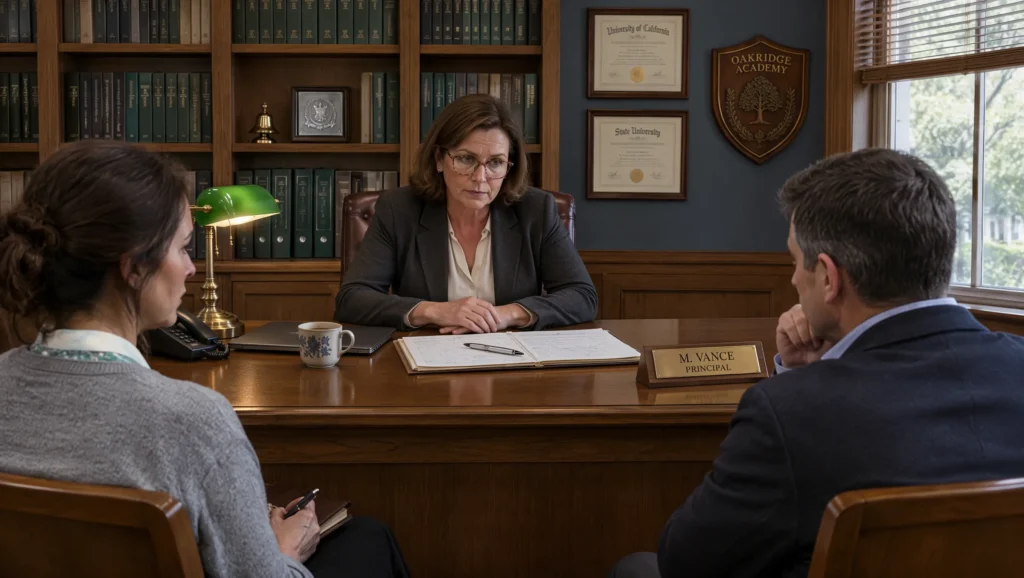
3. Communicate Facts, Not Emotions
You should avoid arguments, harsh words, and defensive explanations. You can explain the school’s rules, assessment procedures, and disciplinary expectations calmly.
The language you use during a difficult conversation is extremely important. A statement that sounds reasonable to you may feel insulting to an already upset parent.
For example, instead of saying, “Your child never studies,” say, “Your child has missed several assignments. Let us discuss how we can improve this situation together.”
The right words can transform conflict into cooperation.
Practical Example: Complaints About Homework
A parent says:
“The school gives too much homework. My child has no time to play, and I have to sit with him every evening.”
A defensive principal might respond:
“All the other parents are satisfied. Why are you complaining?”
Such a response dismisses the parent’s experience and may create unnecessary conflict.
A better response would be:
“I understand your concern about the time your child spends completing homework. Let us review the amount of work assigned and the time your child needs to complete it. We can also discuss whether your child is facing any particular difficulty.”
After the meeting, examine whether the homework is age-appropriate, clearly explained, and reasonably distributed across subjects.
If the workload is excessive, discuss suitable adjustments with the teachers. If the child needs considerable additional time because of learning difficulties, explore ways to provide appropriate support.
Replace Accusations with Constructive Statements
Consider these examples:
| Avoid Saying | Try Saying Instead |
| Your child is very weak. | Your child needs additional support in a few learning areas. |
| Your child never listens. | We need to work together to improve your child’s attention and classroom participation. |
| The teacher is not responsible. | Let us examine the situation and understand what happened. |
| You do not cooperate with the school. | Your involvement can help us support your child’s progress more effectively. |
| Your child deserves these marks. | Let us review the assessment and identify areas for improvement. |
The purpose of communication is not to prove that the principal is right. It is to help everyone understand the situation and identify the next appropriate step.
4. Identify Solutions, Not Someone to Blame
Every complaint should lead to a constructive next step. Agree on what the school will do, what the parents can do at home, and when progress will be reviewed.
You should maintain records of serious complaints and follow up on agreed actions. If an issue involves safety, harassment, or misconduct, investigate promptly and follow the school’s safeguarding procedures.
A complaint should not end with a heated discussion or a vague promise that the principal will “look into the matter.” Parents need to know what will happen next.
Practical Example: A Child Is Not Improving Academically
A parent visits your office and complains:
“My child has been attending this school for three years, but the marks are still low. What are the teachers doing?”
Rather than blaming the child, the parent, or the teacher, examine the student’s academic progress.
Ask the class teacher about classroom participation, assignment completion, attendance, and performance in different subjects. Determine whether the child has difficulty understanding concepts, reading examination questions, writing answers, or completing work within the allotted time.
Suppose the child knows the answers orally but cannot read examination questions independently. In that case, the problem may not be limited to subject knowledge. Reading difficulties may also be affecting examination performance.
The school can then prepare a targeted support plan.
For example:
- The teacher provides short, regular reading practice.
- The parent encourages the child to read for ten minutes daily at home.
- The class teacher monitors progress each week.
- The principal reviews the child’s development after four weeks.
- The school and parents discuss the next steps based on the results.
This approach changes the conversation from “Who is responsible for the poor marks?” to “What can we do to improve the child’s learning?”
Make Every Meeting Action-Oriented
Before concluding a meeting, establish three things:
First, the school’s responsibility: What action will the principal or teacher take?
Second, the parent’s responsibility: What can the parent reasonably do at home?
Third, the follow-up: When will both parties review the progress?
For serious complaints, document the concern, the action taken, and the follow-up required. Maintain confidentiality and share information only with those who need it.
When parents see that the school takes action, they are more likely to develop confidence in its leadership.
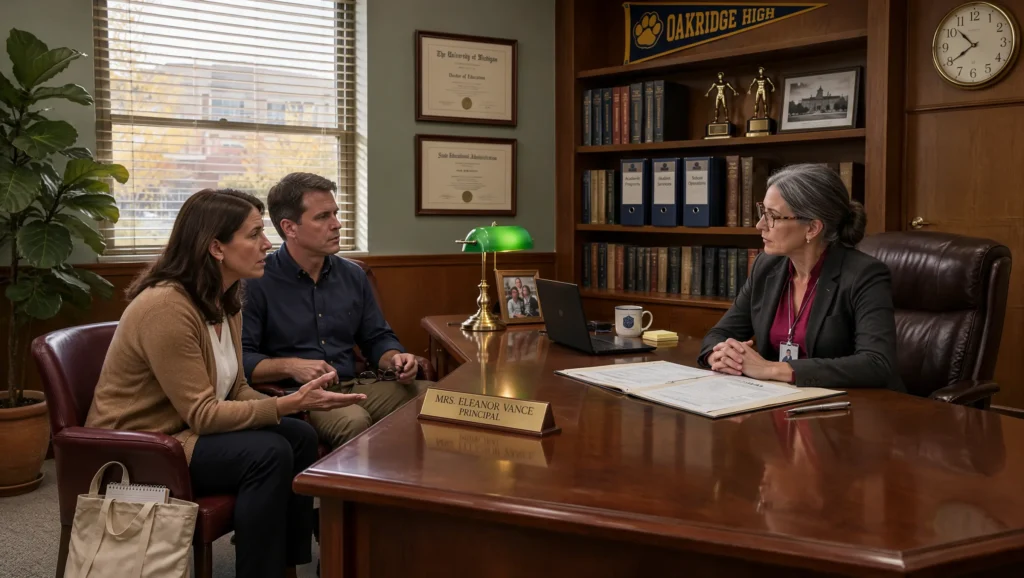
5. Set Respectful Boundaries
Being approachable does not mean accepting abusive language or unreasonable demands. You must establish clear procedures for meetings, complaints, and follow-up. Treat every parent respectfully while expecting the same respect for teachers and school staff.
Some parents may become aggressive when their expectations are not met. They may raise their voices, interrupt repeatedly, threaten to withdraw their children, or demand an immediate decision.
As a principal, you must remain calm without allowing the meeting to become disrespectful or unproductive.
Practical Example: An Angry Parent Insults a Teacher
Imagine that a parent enters your office and begins shouting:
“The teacher does not know how to teach! I want the teacher to come here immediately and answer my questions.”
You should not respond with anger or allow the conversation to become a public confrontation.
Instead, say calmly:
“I am ready to listen to your complaint and examine the issue fairly. However, we must discuss the matter respectfully. Please explain your concern, and I will arrange the appropriate follow-up.”
If the parent continues using abusive language, you may need to pause or end the meeting and arrange another meeting under appropriate conditions.
If there are threats or safety concerns, follow the school’s established procedures.
Establish a Clear Complaint Procedure
Every school should have a transparent system through which parents can raise concerns.
For example:
- Parents may initially discuss routine classroom concerns with the class teacher.
- If the issue remains unresolved, they may approach the coordinator or principal.
- Serious complaints involving safety, harassment, discrimination, or misconduct should be reported promptly through the appropriate school procedure.
- The school should examine the complaint, communicate the next steps, and maintain suitable records.
- Parents should receive an update within a reasonable period, depending on the nature and complexity of the issue.
The school should also explain its meeting timings, communication channels, and expected standards of conduct.
A clear procedure prevents misunderstandings and helps parents understand that their concerns will be heard without unnecessary disruption to teaching and learning.
6. Keep Records, Maintain Confidentiality, and Follow Up
A principal may handle several complaints in a single week. Without proper records, important details can be forgotten, and parents may feel that their concerns have been ignored.
Recording complaints is not about creating unnecessary paperwork. It is about ensuring accountability and consistency.
Practical Example: A Complaint About Bullying
A parent informs you that their child is repeatedly being teased by classmates and is afraid to attend school.
You should not dismiss the concern as a normal disagreement between children. Nor should you immediately accuse another student without examining the facts.
The school should take the report seriously, assess whether the child faces an immediate risk, and initiate an appropriate investigation according to its safeguarding and anti-bullying procedures.
The principal or designated staff member should document the report, record the steps taken, protect the privacy of the children involved, and communicate appropriately with the parents.
The school should also monitor the situation after the initial intervention to determine whether the behaviour has stopped and whether the child feels safe.
In such cases, a single meeting is rarely enough. Follow-up is essential.
What Should a Principal Record?
For significant complaints, maintain a confidential record containing:
- The date and nature of the complaint.
- The main concerns reported by the parent.
- Relevant information gathered from the people involved.
- The action taken by the school.
- Any agreed responsibilities or corrective measures.
- The date and outcome of the follow-up.
Records should be factual, professional, securely maintained, and handled in accordance with the school’s policies and applicable privacy requirements.
Never discuss one child’s disciplinary record, academic difficulties, or personal circumstances with another child’s parents.
A complaint is not truly resolved simply because the parent has left your office. It is resolved when the concern has been examined, appropriate action has been taken, and necessary follow-up has occurred.
7. Build Trust Before a Complaint Arises
The best way to manage parental complaints is to establish strong communication before problems develop.
When parents hear from the school only when their children make mistakes or perform poorly, they may begin to associate school communication with negative experiences.
As a principal, encourage teachers to communicate both concerns and achievements.
A brief message recognising a child’s improvement in reading, helpful behaviour, regular attendance, or classroom participation can strengthen the relationship between home and school.
Practical Example: Communicate Positive Progress
Suppose a student who previously avoided reading aloud begins reading short paragraphs confidently.
The class teacher could send the parent a message:
“Your child has shown encouraging improvement in English reading this week. Regular practice is helping. Please continue supporting ten minutes of reading at home each day.”
Such communication helps parents recognise that the school is observing their child’s development and appreciates progress.
Later, if the school needs to discuss an academic or behavioural concern, the conversation is more likely to take place within an existing relationship of trust.
Conduct Meaningful Parent Meetings
Parent-teacher meetings should not become sessions in which teachers simply read out marks and parents defend their children.
Encourage teachers to discuss three important areas:
- Strengths: What is the child doing well?
- Areas for improvement: What specific skills or behaviours need attention?
- Support plan: What can the school and parents do together?
For example, rather than telling a parent that a child is careless, a teacher can explain that the child frequently leaves written answers incomplete and suggest a short daily writing practice routine.
Specific observations and practical suggestions are more useful than general criticism.
When parents feel that the school recognises their child’s strengths as well as their needs, cooperation becomes easier.
Common Mistakes Principals Should Avoid When Handling Parents’ Complaints
Even experienced principals can make mistakes during stressful conversations. Recognising these common errors can help you respond more professionally.
1. Making an immediate decision: Do not accept or reject an allegation before gathering sufficient information.
2. Publicly criticising a teacher: Discuss professional concerns privately and follow appropriate procedures.
3. Blaming the child: Focus on observable behaviour, learning needs, and possible solutions rather than labelling the student.
4. Making promises you cannot keep: Explain what the school can investigate or change, and avoid guaranteeing an outcome before the facts are established.
5. Ignoring follow-up: Ensure that agreed actions are completed and communicate progress to the parent.
6. Treating every complaint as an attack: A complaint may reveal a genuine weakness in the school’s communication, assessment, discipline, or teaching practices.
7. Ignoring serious allegations: Concerns involving student safety, harassment, discrimination, or staff misconduct require prompt attention and appropriate procedures.
A thoughtful principal does not assume that every complaint is justified, nor does the principal assume that every complaint is an attempt to trouble the school.
The aim is to understand, investigate, and respond fairly.
A Final Thought for Every Principal
You cannot satisfy every parent, and you should not make that your goal. Your responsibility is to make fair decisions, protect children’s interests, support teachers, and build trust through transparent communication.
Some parents will appreciate your explanation. Others may disagree with your decision even after you have examined the facts. That is part of school leadership.
Do not measure your success by the number of complaints you avoid. Measure it by how professionally you handle them, how consistently you apply school policies, and how effectively you protect the interests of children while maintaining a supportive working environment for teachers.
A principal must be approachable without being weak, firm without being rude, supportive of teachers without ignoring their mistakes, and understanding of parents without accepting every demand.
Above all, remember that parents and teachers share an important responsibility: helping children learn, grow, and become responsible individuals.
When both sides understand this shared purpose, disagreements can become opportunities for improvement rather than reasons for conflict.
A good principal does not win arguments with parents. A good principal builds partnerships with them.
Question for School Principals
What is the most challenging situation you have faced while handling a parent’s complaint, and how did you resolve it?
Share your experience in the comments. Your practical insights may help other principals handle similar situations more confidently and professionally.
Frequently Asked Questions (FAQs)
1. How should a principal respond to an angry parent?
A principal should remain calm, listen without interrupting, acknowledge the parent’s concern, gather relevant information, and explain the next steps. Decisions should be based on facts and school policies rather than emotions or pressure.
2. Should a principal always support a teacher when a parent complains?
A principal should support teachers’ professional dignity while investigating every complaint fairly. If the teacher has acted appropriately, the principal should explain the facts. If misconduct or an error is established, appropriate corrective action should follow.
3. How can principals resolve conflicts between parents and teachers?
Principals can resolve conflicts by listening to both parties, identifying the actual issue, examining the evidence, clarifying expectations, agreeing on practical solutions, and following up to assess progress.
4. How should a principal handle a parent who uses abusive language?
The principal should remain professional and clearly request respectful communication. If the behaviour continues, the meeting may be paused or rescheduled according to school procedures. Threats and safety concerns should be handled through appropriate protocols.
5. How can schools prevent frequent parental complaints?
Schools can reduce avoidable misunderstandings through transparent policies, regular parent-teacher communication, timely updates about student progress, clear complaint procedures, and consistent follow-up.
You may like to read:-
- How Principals Should Handle Parents’ Complaints: 7 Practical Strategies
- 10 Practical Techniques for Teachers to Handle Parents’ Meetings Successfully
- Before You Correct a Child, Understand Their Behavior
- 15 Daily Reflection Questions for Modern School Principals
- What Makes a Great Principal? | 10 Must-Have Qualities | Part:2 Strong Communication Skills
Quite educative n essential n effective information for we like Principal….who are striving n struggling for the betterment of Schools…
Your suggestion is our energy.
I am a teacher.so your article is very useful for me.
I will like to know about how a principal can really manage an institution well


Educational & Management Expert, Accredited Teacher & Soft Skills trainer,Certified Counselor,Writer, and Author

There are important techniques to practice for all educators. Appreciate for sharing it.